
Conference Prep on Steroids
Build your custom event CRM with AI in 60 minutes:

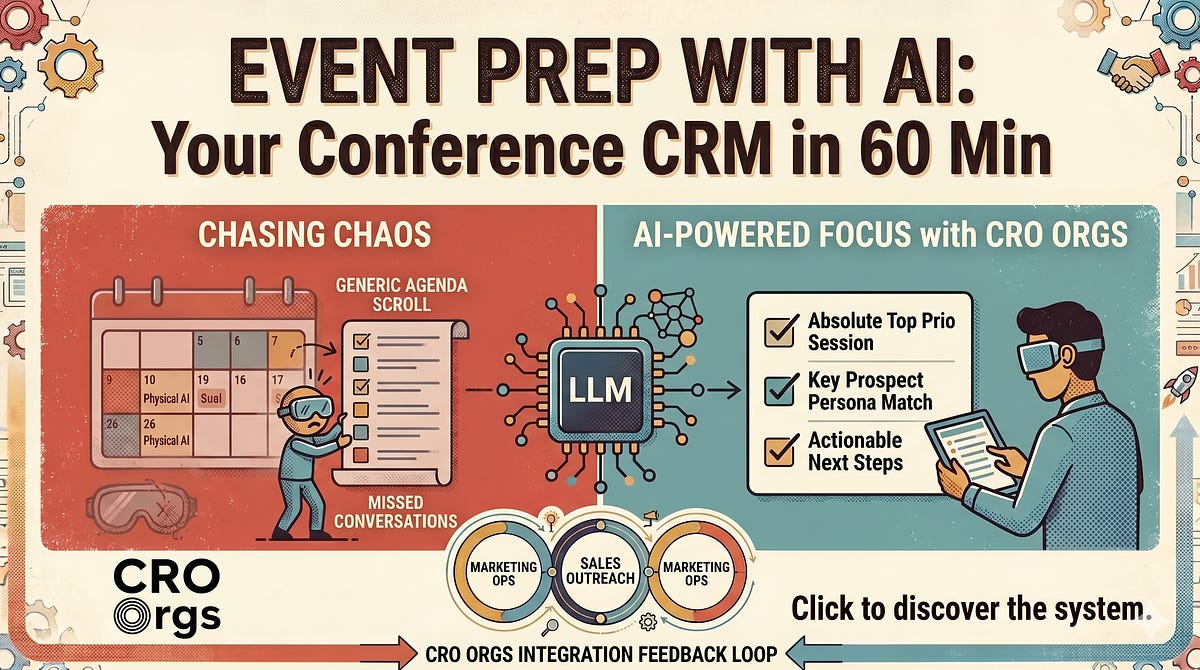
Be honest: What does your typical preparation for a large conference look like? And how much time does it cost your reps to come prepared?
I’ve been to many events in my life, both as a speaker or an attendee. Mostly, my reality looked like this: either I had no time to prepare and simply went to the conference where I let myself drift spontaneously. Or I sat in my hotel room or on the train the night before, opened the (unfortunately often terrible) event app, scrolled through the agenda, and marked a few sessions that caught my eye due to the topic or speaker.
The spontaneous approach definitely has its merits: you are open, you can let curiosity guide you, and often it leads to exciting encounters.
But of course, it also has its downsides. Naturally, it would be great to know precisely who is speaking about the exact topics that are currently occupying my mind. And who wouldn’t want to know in advance the people in attendance who might be particularly interesting to them?
Some event apps try to solve this — but of course, they don’t know my interests, and I have to enter everything from scratch. Plus, their UIs are often not really sleek. In short, none of these solutions have truly convinced me so far.
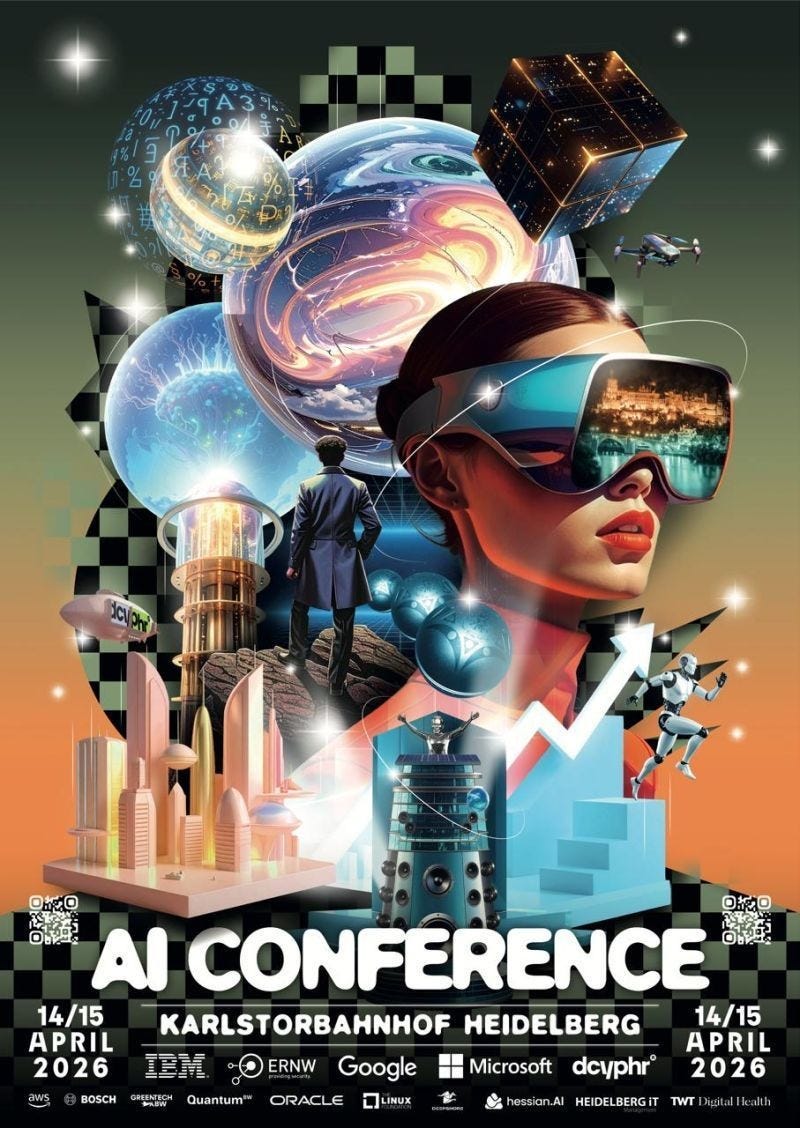
A couple of weeks ago, I found myself at exactly this point again: It was the evening before the AICon in Heidelberg, and I started looking through the agenda. As it turned out, with over 130 speakers and dozens of parallel tracks, it was anything but intuitive. As is normal for most of us these days, my first impulse was: let’s see if my AI can solve this issue for me.
I had two outcomes in mind:
I wanted to have sessions that interest me directly in my calendar, and
I wanted an overview of the people I definitely should speak with based on my guidelines (at this point, depending on your context, this could be your interest profile, your ICP and buyer persona definition, your target investor profile, and so on).
Here is how I reached my goal in +/- one hour:
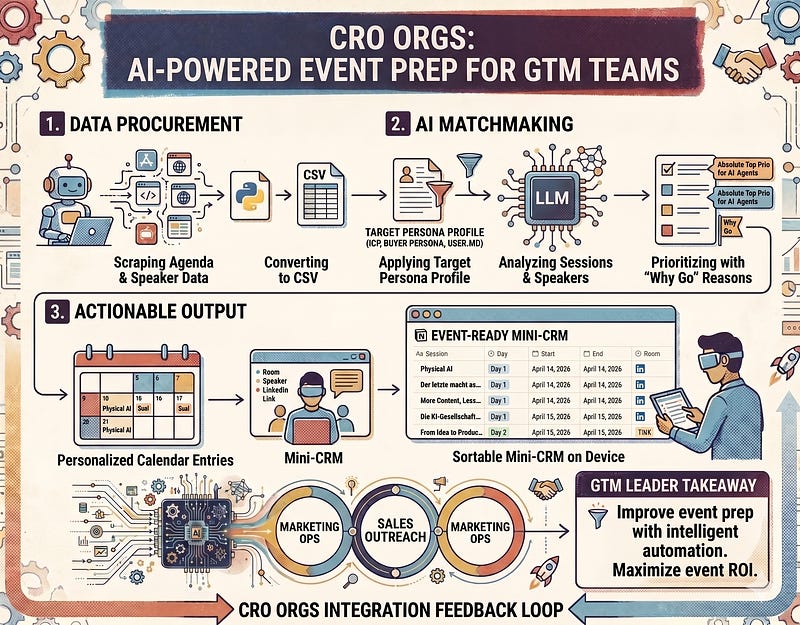
Step 1: Geek Mode (aka Data Procurement)
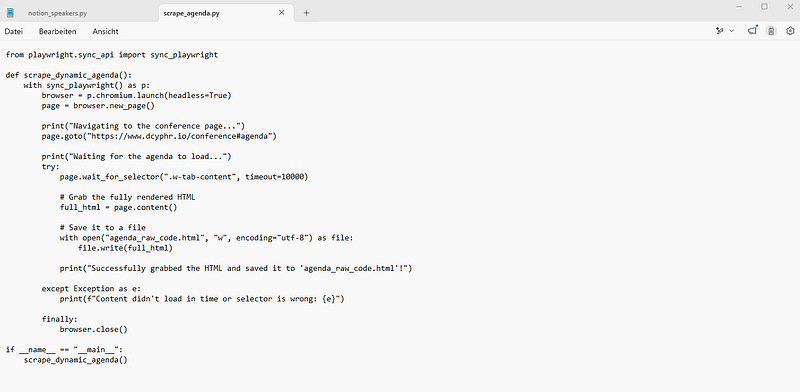
My initial hope was that my LLM could simply “retrieve” the agenda and speaker data from the website. However, that didn’t work cleanly (whether this works depends on the website and the technology used).
So, I had a small Python script written for me that extracted the relevant data. And a second script turned this into a CSV file.
Within a few minutes, I not only had the agenda (incl. days, times, rooms, titles) but also all the speaker profiles with their roles, companies, and background information. And even a link to their photo on the event’s website.
Thanks to AI, you no longer need coding skills for any of this.
Step 2: The Magic Sauce (aka Matchmaking)
However, data in CSV format is not particularly actionable yet. So, I gave the LLM my personal “Target Persona Profile” and an overview of the topics that excite me.
My prompt was roughly along these lines:
Here is the complete conference database. I am interested in the content of
[insert your interests here or refer to your user.md if applicable].
I would like to meet people with the following profile:
[insert the best possible description of the people you want to meet here, e.g., roles, industries, types of companies].
Filter the entire conference data. Compare every session and every speaker with this profile and create a prioritized list for me
a) of the sessions I should attend, as well as
b) of the people I should meet.
The LLM then analyzed the session grid and the 130 speakers and suggested both sessions and interesting people to me. Even directly including a short note on why the respective session or person should be relevant to me (e.g., “Absolute top priority for AI agents” or “Perfect fit for scale-up insights”).
Step 3: Augmented Event Experience (aka Custom Schedule + Event CRM)
I briefly and critically reviewed the suggestions and made a few decisions (actually interesting/not interesting). Then it was time to prepare everything to be “event-ready”.
I wanted my selected sessions directly in my calendar, complete with all the relevant information. With one prompt, I had appointments including room, speaker, and “Why go” reason in my calendar.
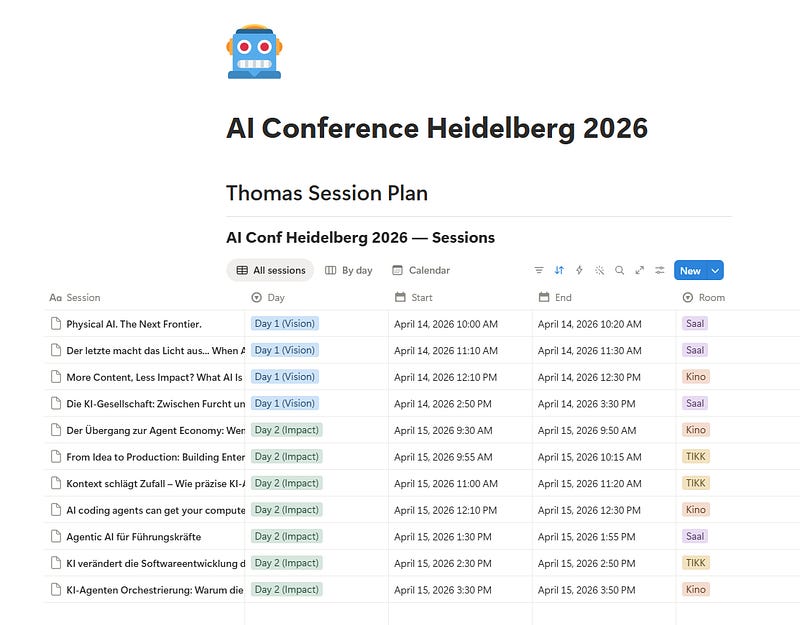
Last but not least, I wanted the events and the selected “VIPs” (very interesting people) in a kind of mini-CRM. As a big Notion fan, it was obvious to create a small database (or rather, have Notion AI set it up and configure it 😅).
The result? I had a sortable mini-CRM on my phone and tablet. Thanks to links to the LinkedIn profiles, I could see at a glance who I should be looking out for. I had actually never been this well-prepared for a conference — and that with just under an hour of effort (next time, it will be even faster).
But how useful did my little setup prove to be in practice?
I attended most of the sessions, skipped others because I was in the middle of interesting conversations. And of course, I didn’t meet all the people who were in my “CRM”. But I did meet some — and a few of them definitely only because I consciously kept my eyes open for them.
Naturally, just like in the past, I also had some very exciting conversations with people the AI didn’t suggest. Even the best tool is no substitute for curiosity and openness. Nevertheless, I am glad that I was better prepared than ever before at the event. And I will do it again.
My Takeaway for GTM Leaders
Why am I sharing this here on CRO Orgs?
Because this 60-minute experiment is a perfect example of how an AI-native GTM organization operates.
A Go-to-Market Operating System for the AI Era

There is a growing gap in B2B go-to-market (GTM). On the one hand, there are teams that use AI tools to do the same things faster - the same sequences and processes, but sprinkled with a tad of shiny automation. On the other hand, there are organizations that are rethinking their entire go-to-market from the ground up. They don’t just buy tools, but c…
What I presented here was my personal workflow. But my approach can be easily standardized and cleverly adapted for an entire team with a few tweaks.
Your RevOps or GTM Engineering person can easily prepare your entire team perfectly for any major industry event with comparable effort.
The result? You no longer send your AEs etc. to expensive events with the instruction “do some networking and collect business cards,” but rather equip them with real intelligence and relevant insights.
I’ll keep on using that exact approach, that much is for sure.