
Stop Optimizing. Start Mattering.
Why AI-native GTM teams should optimize for relevance, not efficiency

Hi!
Today, I may be getting a tad philosophical. I see and hear a lot of talk about AI as a lever for more efficiency. Not only - but also - in GTM. I honestly think that there’s a fundamental misunderstanding at work.
Let me tell you why.
Cheers,
Thomas
When people ask me how to use AI in their GTM motion, the question underneath the question is almost always the same: how do I do more of the same for less? How do I send more outbound, work more accounts, reduce my cost per meeting, keep conversion rates where they are while shrinking the headcount that produces them? These are legitimate operational questions. I don’t dismiss them.
But they are the wrong primary question - and the teams that treat them as such are, I believe, building themselves into a corner they won’t easily escape.
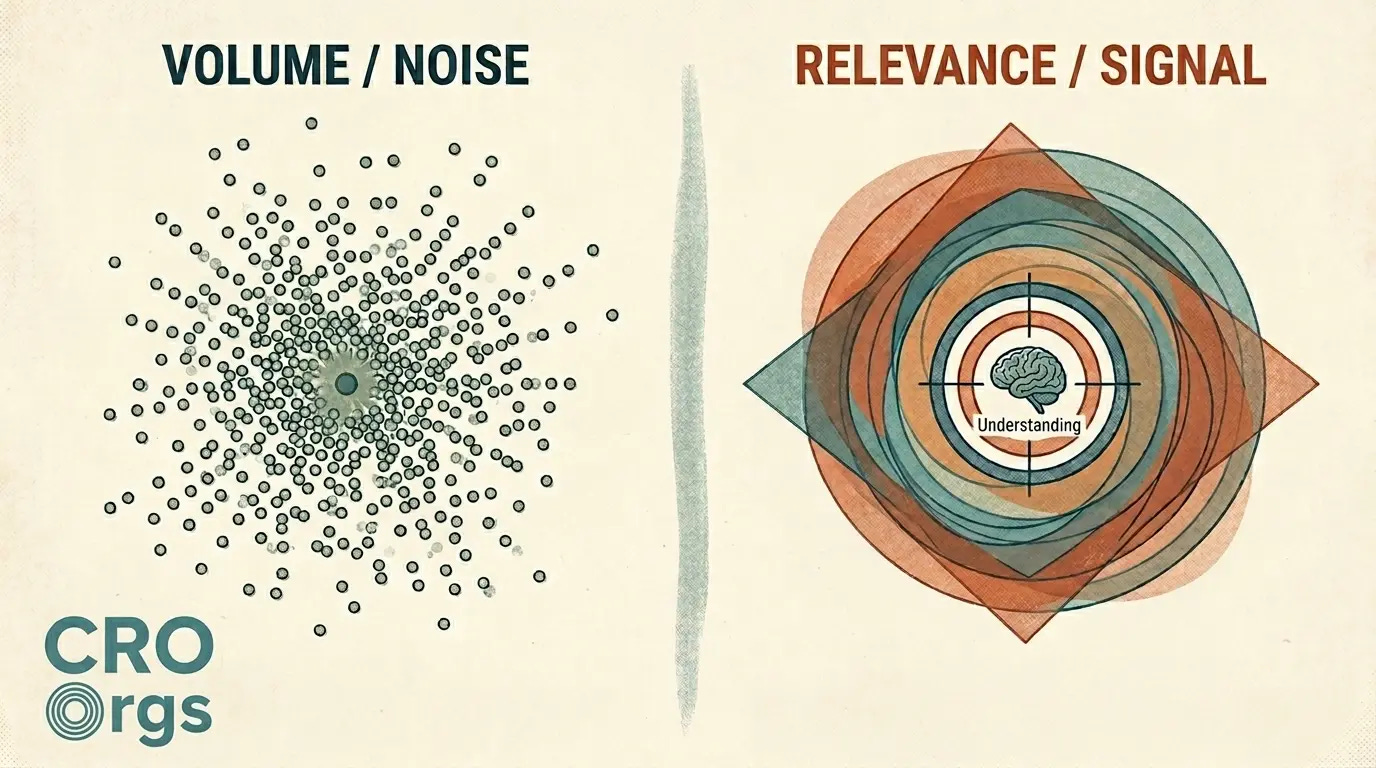
AI doesn’t primarily (necessarily?) make GTM cheaper. It enables something that wasn’t practically achievable before: relevance at scale.
That is a fundamentally different opportunity, and it calls for a fundamentally different frame.
The Efficiency Trap
If you optimize for efficiency, you are pursuing one of two things: lower cost per output, or more output from the same investment. Send more emails for less money. Work more accounts with the same number of reps. Both are defensible goals. But neither creates a durable competitive advantage - because your competitors have access to exactly the same tools.
The result of an industry-wide efficiency race is already visible in our inboxes: more unwarranted messages we don’t care about. As a result, response rates steadily decline because the noise increasingly annoys decision-makers.
Maja Voje recently dubbed the underlying dynamic that was happening in the industry the Sales Tech Sidestep: sales technology, initially promising intelligence and precision, consistently drifted toward volume and automation. And now this playbook is arguably collapsing under its own weight. The GTM industry started an arms race in which everyone loses - except, perhaps, the tool vendors. More teams can reach more people with more pseudo-personalized messages than ever before - and buyers, rationally, have responded by developing a well-calibrated immunity to all of it.
GTM leaders who frame AI with an efficiency angle do not simply fail to solve this problem. They actually accelerate it.
AI-Native GTM Ought To Scale Relevance
Relevance was always the goal of great GTM. Every skilled account executive who spent a week understanding a prospect before picking up the phone, every well-run ABM program, every genuinely customer-centric CS team - all of them were optimizing for relevance. They just couldn’t do it at scale, because the required effort made it cost prohibitive.
I know this tradeoff from both sides. I spent years in consulting, where GTM was almost entirely relevance-driven by design - you built bespoke analyses, you spent weeks mapping a client’s specific situation before proposing anything, and you charged accordingly. Then I ran a SaaS startup, where the model inverted: build once, sell to many, compensate for the lack of bespoke fit with volume, segmentation, and automation.
Traditionally, there has been a fundamental tension between relevance and scale that nobody had a satisfying answer to, the last generation of customization and automation solutions notwithstanding. You could have one or the other; having both required either exceptional talent or exceptional budget.
That tension is now dissolving. AI removes the production cost constraint that kept granular relevance in the domain of high-touch, expensive professional services. What was reserved for your top ten accounts - the deep research, the contextually precise solution, the conversation that arrives at exactly the right moment - can now apply to your top thousand. I expect that GTM, in particular for enterprise software, will increasingly mimic professional services and deliver consulting-grade relevance at software-grade economics. The rise of the forward deployed engineer at AI-native companies is an early organizational signal of exactly this convergence.
Three components of relevance
Operationally, scaling relevance has three components that need to work together.
The first is a deep understanding of your customer - not just firmographics and technographics, nah, it’s about having a clear picture of where a specific customer is in their journey and what problem they are actively trying to solve right now. Second is context-fit messaging (and distribution) across every stage, from the first signal through closing, expansion, and renewal. The third - and maybe most underappreciated - is timing.
It has always been easiest to sell to customers who know they have a problem and want it solved. AI-native GTM makes meeting a customer at that point and introducing a solution that actually matches their need achievable at scale.
Beyond GTM: Products Will Become More Relevant Too
The most forward-thinking software companies are already drawing the same logic one step further. If AI can help you understand what a customer needs and deliver it to them in the right form at the right moment - why would that stop at the sales conversation?
Custom dashboards are already table stakes. What is coming, enabled by AI that can write and reconfigure code in real time, are products that adapt their own interfaces, workflows, and experiences to how individual companies and users actually work. The line between GTM and product blurs when the product itself becomes the most relevant surface in the customer relationship. Good CROs already understand this intuitively - the best ones have always known that product and GTM are not separate problems.
Scaling Relevance Gone Wrong
Two words of warning, though.
It’s easy to produce pseudo-relevance at scale with AI: longer research briefs no AE ever reads, industry-specific snippets that your client doesn’t relate with, or a prospect’s recent LinkedIn post referenced in line three - but its context misinterpreted . All that is still broadcasting. Even personalized AI slop is still slop. The test is not whether your outreach looks tailored; it is whether it is actually relevant to the person receiving it.
The second failure mode is less obvious but, I’d argue, more consequential. That is, you could maybe conclude that AI handles understanding the customer and humans simply greenlight its output. That is not how it works. AI is a tool - and in the right hands a powerful one at that - but not more than that. It is great at surfacing information, at synthesizing it, and at creating relevant output, given it has the right context, knowledge, and supervision.
But proper customer understanding is still a skill that firmly sits in the human domain. It still requires people on GTM teams who genuinely care about the customer, who can make customers feel understood, who can sense when something is off, who critically evaluate what the system produces rather than treating it as finished work. The work changes substantially. The need for exceptional GTM people does not. They simply operate by a new paradigm.
The Shift to Relevance (tl;dr)
In recent GTM history, the dominant advantage was reach - the biggest list, the most reps, the most channels, the loudest signal. But now that well-implemented AI makes relevance scalable, the variable that determines outcomes changes as well: How well do you understand the people you are trying to serve - and is your system built to act on that understanding at every touchpoint?